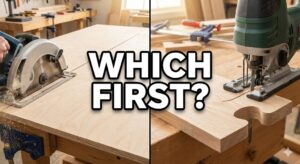
You have your safety glasses. You have your tape measure. You have a head full of project ideas. But now you are standing in the power tool aisle, staring at two very different machines, wondering:
“Which saw do I actually need?”
On one hand, you have the Circular Saw, the loud, aggressive beast that looks like it means business. On the other hand, you have the Jigsaw, the smaller, friendlier-looking tool that seems much easier to handle.
Both cut wood. Both are affordable. But if you only have the budget for one, which one should you buy?
This is one of the most common debates for beginner woodworkers. The answer isn’t just about “which is better”—it’s about what you want to build.
In this guide, we will break down the strengths and weaknesses of both saws, compare them head-to-head, and help you decide which one deserves the first spot on your shelf.
The Contender #1: The Circular Saw
The “Table Saw” in Your Hand.
A circular saw is exactly what it sounds like: a round blade with sharp teeth that spins at high speed to cut through wood. It is designed for one main purpose: Cutting straight lines fast.
What is it Best For?
Breaking Down Sheet Goods: If you need to cut a 4×8 sheet of plywood in half, this is the tool.
Dimensioning Lumber: Cutting 2x4s to length for framing or furniture.
Long, Straight Cuts: When paired with a straight-edge guide, a circular saw can cut as straight as a massive table saw.
Pros:
Speed: It rips through wood like butter.
Straightness: The large blade acts as a stabilizer, making it easier to keep a line straight.
Depth: Most circular saws can cut through thick lumber (up to 2.5 inches) in a single pass.
Clean Cuts: With a high-tooth blade, you can get furniture-quality edges.
Cons:
Intimidation Factor: It’s loud, throws a lot of dust, and can be scary for beginners due to “kickback” (when the saw jumps back at you).
Zero Curves: You cannot cut curves. Don’t even try. You will burn the wood and bind the blade.
Safety: It requires more respect and safety knowledge than a jigsaw.
The Contender #2: The Jigsaw
The Artist’s Paintbrush.
A jigsaw features a small, thin blade that moves up and down (reciprocating). Unlike the circular saw, the blade is narrow, which allows you to turn the tool while cutting.
What is it Best For?
Curves and Shapes: Cutting circles, arches, or intricate patterns (like letters or puzzle pieces).
Notches: Cutting corners out of a shelf to fit around a pillar.
Safety: It is much quieter, creates less dust, and generally feels safer to use than a spinning circular blade.
Pros:
Versatility: It can cut straight (sort of), curves, and even bevels.
User-Friendly: Less scary for new woodworkers. The blade is small and moves slower visually.
Cheap Blades: You can switch blades in seconds to cut wood, metal, plastic, or tile.
Plunge Cuts: You can start a cut in the middle of a board (like cutting a hole for a sink in a countertop).
Cons:
Wobbly Lines: It is notoriously difficult to cut a perfectly straight line with a jigsaw. The blade tends to wander.
Blade Deflection: Because the blade is thin and supported only at the top, it can bend inside the wood. Your cut might look straight on top but be crooked on the bottom.
Slow: It cuts much slower than a circular saw.
Head-to-Head Comparison
Let’s compare them on the factors that matter most to a beginner.
1. Accuracy (Straight Cuts)
Winner: Circular Saw 🏆
If you are building a Shoe Rack or a Laptop Stand, you need square, straight cuts. A circular saw does this naturally. A jigsaw requires intense focus to keep straight, and even then, it will likely be wavy.
2. Versatility
Winner: Jigsaw 🏆
A jigsaw can technically do everything (straight cuts, curves, cutouts). A circular saw can only do straight cuts. If you need to cut a circle for a cornhole board or a heart shape for a gift, the circular saw is useless.
3. Safety (For Beginners)
Winner: Jigsaw 🏆
The jigsaw is the least intimidating power saw. Kickback is rare and usually mild. If you let go of the trigger, the blade stops quickly. The circular saw demands you understand kickback mechanics and proper body positioning.
4. Setup Cost
Winner: Tie 🤝
You can find decent entry-level models for both tools for under $50. (Check out our guide on Tools Under $50).
The Verdict: Which One Should YOU Buy?
The answer depends entirely on what you plan to build first.
Buy the CIRCULAR SAW First If…
Your goal is to build furniture (Bookshelves, tables, planter boxes, benches).
You need to use plywood or wide boards.
You value precision and square edges over “artsy” shapes.
Why: You simply cannot build a stable table or shelf if your cuts are wavy. The circular saw is the foundation of structural woodworking.
Buy the JIGSAW First If…
Your goal is to make crafts (Wooden signs, cut-out shapes, decor items).
You are terrified of the circular saw and want to ease into power tools gently.
You plan to work mostly with thin wood (1/2 inch or less).
Why: If you aren’t building structural box-like items, the jigsaw offers more creative freedom.
My Recommendation for Beginners
If I had to choose just one tool to start a general woodworking shop, I would choose the Circular Saw.
Why? Because 90% of woodworking is cutting straight lines. With a circular saw and a straight board clamped down as a guide, you essentially have a table saw. You can build cabinets, desks, and shelves. With a jigsaw, you will struggle to make those same cuts straight, and your furniture might end up looking “homemade” (in a bad way).
The Ideal Path:
Buy a Circular Saw first to build your workbench and storage.
Buy a Jigsaw later when you want to add decorative curves to those projects.
Frequently Asked Questions (FAQs)
Q: Can I use a jigsaw to cut 2x4s? A: Yes, you can. However, it will be slow, and the blade might bend, resulting in a cut that isn’t perfectly square (90 degrees). For framing, a circular saw is much better.
Q: Do I need a cordless saw? A: For a circular saw, “Corded” is better for beginners (more power, cheaper). For a jigsaw, “Cordless” is very nice because you turn the tool a lot and the cord gets in the way.
Q: Which blade should I buy?
Circular Saw: Get a 40-tooth or 60-tooth “Carbide Tipped” blade for smooth plywood cuts.
Jigsaw: Get a “clean cut” wood blade (teeth point down) for smooth finishes.