If you ask any professional woodworker what their “most requested” item is, they will likely say: A cutting board.
A handmade wooden chopping board is more than just a kitchen tool. It is a statement piece. It is the perfect handmade gift for birthdays, weddings, or housewarmings. And the best part? It looks incredibly expensive, but you can build one this weekend with just a few strips of wood and some glue.
Many beginners are intimidated by cutting boards because they look complex. How do you get those perfect stripes? Is it safe to put food on it? What kind of oil do you use?
Don’t worry. In this guide, I will show you how to build a stunning “Edge Grain” cutting board that will last for decades.
The Golden Rule: Food Safety First
Before we cut a single piece of wood, we need to talk about safety. Not all wood is safe for food.
Avoid Softwoods: Never use Pine, Fir, or Cedar for a cutting board. They are too soft, and knife cuts will create deep grooves where bacteria can grow.
Avoid Open-Grain Woods: Red Oak has open pores (like tiny straws) that trap meat juices and bacteria.
The Best Woods to Use: You need tight-grain hardwoods. The “Holy Trinity” of cutting board woods are:
Maple (Light color, very hard)
Walnut (Dark chocolate color, classic look)
Cherry (Reddish hue, darkens with age)
For this project, we will use a mix of Maple and Walnut to create a beautiful contrasting stripe pattern.
Materials & Tools List
Materials
Hardwood Boards: About 2-3 board feet of Maple and Walnut (approx 1 inch thick).
Waterproof Wood Glue: This is critical. You must use a glue like Titebond III. It is FDA-approved for indirect food contact and is waterproof. Do not use standard white school glue!
Mineral Oil: For the finish (Found in the pharmacy section, usually sold as a laxative—it’s food safe!).
Beeswax (Optional): To make a conditioning paste.
Tools Needed
Table Saw or Circular Saw: To rip the wood into strips. (Check our Power Tools Guide if you are buying your first saw).
Clamps: You can never have enough clamps. You need at least 3-4 pipe or bar clamps.
Sander: An orbital sander is best.
Planer (Optional): If you don’t have one, you can use a hand plane or just a lot of sanding!
Step 1: Milling and Cutting Strips
The design of your board depends on how you cut your wood.
Decide the Thickness: We want our final board to be about 1.5 inches thick.
Cut the Strips: Set your table saw fence to 1.5 inches. Rip your Maple and Walnut boards into long strips.
Inspect: Throw away any strips with knots, cracks, or defects. These will trap food later.
Step 2: The Design (Arranging the Pattern)
This is the fun part.
Lay your strips on your workbench.
Flip them on their side: We want the “Edge Grain” facing up. This makes the board harder and keeps your knives sharper.
Play with the pattern: Try different arrangements.
Symmetrical: Walnut-Maple-Walnut-Maple-Walnut.
Random: A thick Walnut piece, a thin Maple stripe, etc.
Once you love the design, mark a “V” across the top of all boards with a pencil. This helps you keep them in order during gluing.
Step 3: The Glue Up (The Sticky Part)
This step must be done quickly.
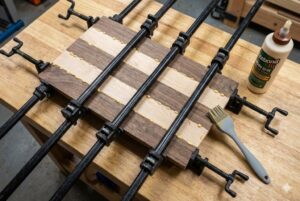
Setup: Lay your clamps open on the table. Place a piece of wax paper or plastic under them so the glue doesn’t stick to your clamps.
Apply Glue: Take the strips and rotate them 90 degrees. Apply a generous bead of waterproof glue to the face of every strip (except the very last one).
Spread it: Use a silicone brush or your finger to spread the glue to cover 100% of the surface.
Clamp it: Rotate the strips back and push them together. Tighten your clamps.
Squeeze Out: You should see beads of glue squeezing out of every joint. If you don’t see squeeze-out, you didn’t use enough glue!
Wait: Let it dry for at least 24 hours. Don’t rush this.
Step 4: Flattening the Board
After the glue dries, your board will probably look a little messy and uneven.
Remove Glue: Scrape off the dried glue blobs with a paint scraper.
Flatten: If you have a thickness planer, run the board through it. If not, use a belt sander or your orbital sander with 80-grit sandpaper.
Sand, Sand, Sand: This is where the magic happens. Sand the entire board with 80 grit until it is perfectly flat. Then move to 120 grit, then 180, and finally 220 grit.
Warning: Don’t leave “pigtail” swirls! Read our guide on Common Woodworking Mistakes to perfect your sanding technique.
Step 5: Cutting to Size and Routing
Trim the Ends: Use your saw to cut the jagged ends of the board off, making it a perfect rectangle.
Round the Edges: Sharp corners on a cutting board are uncomfortable. Use a router with a “Roundover Bit” or sandpaper to soften all the edges.
Step 6: The “Water Pop” (Pro Secret)
Most beginners skip this, and their board feels “fuzzy” after the first wash.
Wipe the board with a damp wet cloth.
Let it dry. You will feel the grain “stand up” and feel rough.
Sand it again lightly with 220 grit sandpaper.
Now, your board will stay smooth forever.
Step 7: The Finish (The Most Satisfying Moment)
This is the moment every woodworker lives for.
Pour a generous amount of Mineral Oil onto the wood.
Watch as the dry wood soaks it up and the colors explode! The Walnut will turn deep chocolate, and the Maple will shine like gold.
Let it soak for 20 minutes, then wipe off the excess.
Optional: For extra protection, apply a “Board Butter” (a mix of melted beeswax and mineral oil) as a final coat.
How to Care for Your New Board
Since this is a natural product, you can’t treat it like plastic.
NEVER put it in the dishwasher. The heat and water will crack it instantly.
Wash with warm soapy water and dry immediately.
Re-oil it once a month (or whenever it looks dry).
Conclusion
Making a cutting board is a rite of passage. It teaches you the importance of flat lumber, good glue joints, and patience with sanding.
Plus, every time you chop vegetables for dinner, you’ll get a little spark of joy knowing, “I made this.”
What wood combination are you going to try? I’m partial to the classic Walnut and Maple, but Purpleheart and Cherry look amazing too!
Frequently Asked Questions (FAQs)
Q: Can I use vegetable oil or olive oil to finish the board? A: NO! Never use cooking oils (olive, corn, vegetable). They will go rancid (spoil) over time and make your board smell terrible. Only use Mineral Oil or specialized Butcher Block Oil.
Q: My board wobbles on the counter. What happened? A: It likely warped during the glue-up or sanding. You can fix this by attaching small rubber feet to the bottom. This not only stops the wobble but also prevents the board from sliding while you chop.
Q: How thick should a cutting board be? A: Ideally, between 1.25 inches and 2 inches. Thinner boards (under 1 inch) are more likely to warp over time.