If you are currently building woodworking projects on your garage floor, your knees (and your back) probably hate you. I know mine did.
When I started, I thought I needed to buy a fancy $500 professional workbench. But the truth is, you don’t. The best workbench for a beginner is one you build yourself. It is cheaper, sturdier, and you can make it fit your space perfectly.
In this guide, I am going to show you how to build a super simple, rock-solid workbench using basic construction lumber (2x4s) and a sheet of plywood.
You can build this in a single afternoon, and it will cost you less than $100. No complex joinery, no fancy tools—just simple, strong woodworking.
Let’s get off the floor and start building!
Why Build This Workbench?
Before we run to the hardware store, let’s talk about why this design is perfect for beginners.
It’s Solid: We are using 2x4s, which are strong enough to hold heavy tools.
It’s Customizable: You can change the height or width to fit your garage.
It’s Cheap: We are using standard lumber, not expensive hardwoods like Oak or Walnut.
Minimal Tools Required: If you read our guide on the 7 Must-Have Tools for Beginners, you already have everything you need.
The Materials & Tools List
Here is your shopping list. You can get all of this at your local Home Depot, Lowe’s, or lumber yard.
Materials (Lumber)
(6) 2×4 boards (8 feet long): These will be the legs and the frame.
(1) Sheet of 3/4-inch Plywood or MDF: This will be your table top. (Have the store cut it for you if it doesn’t fit in your car!)
(1) Box of 2.5-inch wood screws: For assembling the frame.
(1) Box of 1.25-inch wood screws: For attaching the top.
Tools Needed
Circular Saw: To cut the 2x4s.
Cordless Drill: To drive the screws.
Tape Measure: Accuracy is key here! (Review our Tape Measure Guide if you need a refresher).
Safety Glasses: Always protect your eyes from sawdust.
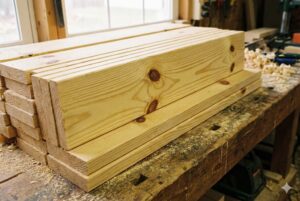
Step 1: The Cut List (Measure Twice, Cut Once)
First, we need to cut our wood to size.
Pro Tip: Use a Speed Square to mark straight lines before you cut.
Cut your 2x4s into these pieces:
Legs: 4 pieces at 34 inches long. (This makes a standard height bench. Adjust if you are very tall).
Long Frame Rails: 4 pieces at 45 inches long.
Short Frame Rails: 4 pieces at 21 inches long.
Cut your Plywood Top:
1 piece at 24 inches x 48 inches (This is your bench top).
(Optional) 1 piece at 24 inches x 48 inches (For a bottom shelf).
Step 2: Assemble the Top and Bottom Frames
We are going to build two identical rectangles (boxes). One will support the top, and one will be the bottom shelf frame.
Lay out two Long Rails (45″) and two Short Rails (21″) on the floor.
Place the short rails inside the long rails to form a rectangle.
Drill Pilot Holes: Before driving screws, drill a small hole. This prevents the wood from splitting.
Drive two 2.5-inch screws into each corner.
Repeat this process so you have two identical wooden rectangles.
Step 3: Attach the Legs
Now we need to turn these frames into a table.
Lay one frame flat on the floor (this is your top frame).
Place a Leg (34″) inside one corner of the frame.
Flush the top of the leg with the top of the frame.
Clamp it tight (if you have clamps) and screw the frame into the leg from the outside using 2.5-inch screws. Use 3 or 4 screws per leg for strength.
Repeat for all four legs.
Now flip the table over so it is standing on its legs. It might be a little wobbly right now—don’t worry, the bottom shelf will lock it in place.
Step 4: Add the Bottom Shelf Support
The bottom shelf adds storage, but more importantly, it stops the table from wobbling.
Measure 6 inches up from the bottom of each leg and make a mark.
Slide your second rectangular frame (from Step 2) inside the legs.
Line it up with your 6-inch marks.
Screw the legs into this bottom frame.
Now, give the table a shake. It should feel incredibly solid. That structure is called “racking resistance,” and it’s why we use two frames.
Step 5: Attach the Table Top
You are almost done!
Place your Plywood Top (24″ x 48″) on the top frame.
Align the edges so they are flush with the frame.
Using your 1.25-inch screws, screw down through the plywood into the frame underneath.
Put one screw in each corner and one in the middle of each side.
Countersink the screws: Drive the screw head slightly below the surface of the wood so it doesn’t scratch your projects later.
(Optional: Do the same for the bottom shelf if you cut a piece for it.)
Step 6: Sanding and Finishing
Technically, your workbench is done. But a true woodworker takes pride in the finish.
Sand the Edges: Use your sander or a piece of sandpaper to smooth out the sharp edges of the plywood. You don’t want to get splinters every time you lean against it.
Protection: Since this is a garage workbench, you don’t need to stain it. However, applying a simple coat of boiled linseed oil or polyurethane will protect it from glue spills and oil stains.
Conclusion: Your First Real Project
Congratulations! You just built your first piece of shop furniture.
Take a step back and look at it. It’s simple, yes. But it is yours. You measured it, you cut it, and you assembled it.
Now, you have a flat, stable surface to work on. No more crawling on the concrete floor. This workbench will serve you for years, and one day, you’ll look back at it and remember where your journey started.
Now, go put some sawdust on it!
Frequently Asked Questions (FAQs)
Q: Can I put wheels (casters) on this workbench? A: Yes! If you add wheels, remember to subtract the height of the wheels from your leg length (Step 1), otherwise, your table might be too tall.
Q: Is MDF better than Plywood for the top? A: MDF is flatter and heavier, which is great for a workbench. However, MDF hates water. If your garage is damp or you spill water on it, MDF can swell. Plywood is more durable against moisture.
Q: How do I make the bench bigger? A: The design is scalable. If you want an 8-foot bench, just buy longer 2x4s for the “Long Rails” and a larger sheet of plywood. The construction steps remain exactly the same.