Walking into a lumber yard or the wood aisle of a big-box store can be intimidating. You are surrounded by stacks of boards of varying colors, weights, and price tags. For a beginner, the question isn’t just “What looks good?” but rather “What is forgiving enough for me to learn on?”
Choosing the right wood is the first step to a successful project. Pick something too hard, and you might dull your tools or struggle to make straight cuts. Pick something too expensive, and the fear of making a mistake will paralyze you.
This guide breaks down the best wood types for beginners, focusing on workability, cost, and availability.
Why Workability Matters More Than Looks
When you are just starting, your primary goal is to learn techniques—sawing, chiseling, gluing, and finishing. You need a material that cooperates.
“Workability” refers to how the wood responds to tool edges. Does it cut cleanly, or does it splinter? Does it take a nail without splitting? Highly workable woods allow you to focus on your craftsmanship rather than fighting the material.
Pro Tip: Don’t buy your “dream wood” (like Walnut or Mahogany) for your first project. Start with cheaper, softer woods. If you make a measuring mistake on a $5 board, it’s a lesson. If you do it on a $50 board, it’s a tragedy.
Softwood vs. Hardwood: A Quick Primer
Softwoods (Gymnosperms): Conifers (cone-bearing trees) like Pine, Fir, and Cedar. They generally grow faster, are cheaper, and are easier to cut.
Hardwoods (Angiosperms): Deciduous trees (leaf-dropping) like Oak, Maple, and Walnut. They usually have tighter grain patterns and are more durable.
For beginners, the sweet spot is often found in specific softwoods and softer hardwoods.
Top Softwoods for Beginners
Softwoods are the classic starting point. They are readily available at home centers (like Home Depot or Lowe’s) and are easy on your budget.
1. Pine
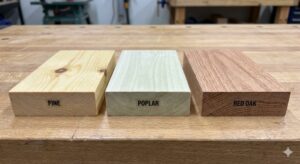
Pine is the undisputed king of beginner woodworking. It is incredibly soft, meaning you can cut it easily with a hand saw or a jigsaw without much resistance. It is also the most affordable wood you will find.
Best For: Rustic furniture, shelving, painting projects, and shop fixtures.
The “Human” Reality: Pine has a reputation for being “cheap,” but seasoned woodworkers love it. However, be warned: Pine can be frustrating to stain. Because the grain is uneven, it often absorbs stain blotchily, looking muddy.
Workability: 10/10. It cuts like butter.
Note: Always use a “Pre-Stain Wood Conditioner” if you plan to stain pine. It helps even out the absorption.
2. Cedar (Western Red Cedar)
If you want to build something for your patio or garden, skip the Pine and grab Cedar. It has natural oils that make it resistant to rot, bugs, and moisture without needing chemical treatment.
Best For: Outdoor furniture, birdhouses, planter boxes.
Sensory Experience: One of the best parts of working with Cedar is the smell. It fills the shop with a distinct, spicy aroma.
Workability: Very soft and easy to cut, though it can sometimes be brittle.
3. Douglas Fir
Often found in the construction lumber section (2x4s), Fir is stronger and harder than White Pine. It has a very distinct, straight grain pattern and a reddish-orange hue.
Best For: Heavy-duty workbenches, table bases, and structural frames.
The Catch: Fir can be stringy. If your saw blade isn’t sharp, the wood fibers might tear out rather than cut cleanly. It also splinters easily, so always wear gloves when handling rough stock.
Top Hardwoods for Beginners
Once you are comfortable with Pine, you will likely want to “graduate” to hardwoods to make nicer indoor furniture. However, you don’t want to jump straight to rock-hard woods like Hickory or hard-to-glue woods like Teak.
4. Poplar
Poplar is often called the “training wheels” of the hardwood world. It is technically a hardwood, but it is quite soft—sometimes even softer than some pines. It is inexpensive and mills beautifully.
Best For: Painted furniture, drawer parts, and interior trim.
Why It’s Great: It doesn’t have sap or pitch pockets like pine, so your tools stay cleaner.
Aesthetic Note: Poplar is infamous for its color. It often has streaks of green, purple, or black running through the creamy white wood. Because of this, most woodworkers paint poplar. If you leave it in the sun, the green eventually turns brown, but it’s rarely used for “fine” natural-finish furniture.
5. Red Oak
Walk into any American home built in the 1980s or 90s, and you will see Red Oak cabinets and floors. It is the standard for durability. It is much harder than the woods listed above, so it will require sharper tools and a bit more muscle, but it is very forgiving.
Best For: Tables, bookcases, cabinets.
Workability: Oak has a very open grain (it looks like tiny straws packed together). This texture hides minor sanding mistakes effectively.
The Smell Test: You can identify Red Oak by its smell when cut—it has a distinct, vinegary scent that some people find unpleasant when the wood is wet, but it fades quickly.
6. Soft Maple
Don’t confuse this with “Hard Maple” (Sugar Maple), which is used for bowling alleys and baseball bats and is very difficult to work with. Soft Maple gives you that beautiful, creamy, high-end look without burning your saw blades.
Best For: Fine furniture, cutting boards (it is food safe), and shaker-style cabinets.
The Challenge: Unlike Oak, Maple has a tight, closed grain. This means it shows scratches easily. You have to be very diligent with your sanding, or the finish will highlight every flaw.
Wood Types to Avoid (For Now)
Just as there are good woods to start with, there are woods that will make you want to quit the hobby.
Reclaimed Pallet Wood: It’s trendy and free, but pallet wood is often filled with hidden nails and grit that will destroy your tools. It may also be treated with harsh chemicals (methyl bromide) that are unsafe to breathe when sawing.
Exotics (Rosewood, Ebony, Cocobolo): These are incredibly expensive, oily (hard to glue), and often toxic/allergenic.
Construction Plywood (Sheathing): Stick to “cabinet grade” plywood like Baltic Birch. Cheap sheathing plywood has voids and gaps that look terrible on furniture.
Where Should You Buy Your Wood?
This is a common hurdle for beginners.
The Big Box Store (Home Depot/Lowe’s):
Pros: Convenient, open late, clearly priced.
Cons: The wood is often wet (high moisture content), meaning it might twist or warp as it dries in your garage. You have to sort through 20 boards to find one straight one.
The Lumber Yard / Hardwood Dealer:
Pros: Better quality, dry wood, knowledgeable staff, wider selection.
Cons: Can be intimidating. They often sell rough-sawn wood that requires a planer and jointer to smooth out.
Advice: Look for wood labeled S4S (Surfaced 4 Sides). This means the lumber yard has already flattened and squared the board for you. It costs a bit more, but for a beginner without heavy machinery, it is essential.
Final Thoughts: Just Cut Something
The best wood for a beginner is the wood you have access to. If all you can find is Pine, build something beautiful out of Pine. The skills you learn—measuring twice, cutting once, and keeping your fingers safe—translate to every species.
Start with a simple project, perhaps a box or a small step stool, using Poplar or Pine. Accept that the first one won’t be perfect. Woodworking is a subtractive art; once you take the wood away, you can’t put it back. But that’s the thrill of it.
Grab a board, make some sawdust, and build something that lasts.