If there is one tool that acts as the heartbeat of a workshop, it’s the cordless drill.
Whether you are building a simple bookshelf, hanging cabinets, or assembling a jig, you will reach for your drill more than any other tool. But if you walk into a hardware store today, you are greeted by a “Wall of Confusion”—dozens of brands, voltages, and acronyms like “XR,” “Fuel,” and “Brushless.”
For a home woodworker, buying the wrong drill is frustrating. A heavy construction drill will tire your arm out during delicate furniture assembly, while a cheap underpowered drill will stall when you try to drill into hardwood.
In this guide, I’ve cut through the noise to bring you the best cordless drills for home woodworking in 2026. These picks balance power, precision, and price, specifically for the needs of a DIY shop.
Buying Guide: What Woodworkers Actually Need
Before we look at the models, let’s define what makes a drill good for woodworking. This is different from general construction.
1. 12V vs. 18V/20V: The Great Debate
12V Drills: These are smaller, lighter (often under 2.5 lbs), and fit into tight spaces (like inside a cabinet). For 80% of furniture projects, a modern 12V drill has plenty of power.
18V (or 20V) Drills: These are the industry standard. They have the torque to drive large lag bolts and drill massive holes. If you plan to build decks or larger outdoor projects, go with 18V.
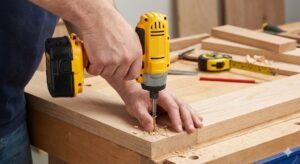
My Advice: If this is your only drill, get an 18V/20V model for maximum versatility. If you already have a big drill, get a 12V for delicate work.
2. Brushed vs. Brushless Motors
You will see “Brushless” printed in big letters on expensive boxes.
Brushed: Older technology. Less efficient, gets hotter, and battery dies faster. Cheaper upfront.
Brushless: Smart electronic magnets adjust power usage. They run cooler, last 50% longer on a charge, and are more powerful.
My Advice: In 2026, buy Brushless. The price gap has closed, and the tool life is significantly better.
3. The Clutch (Crucial for Woodworking)
See the collar with numbers (1-20) behind the chuck? That’s the clutch. It stops the drill from spinning once it meets a certain resistance.
Why it matters: Without a good clutch, you will accidentally drive screws too deep, cracking your wood or burying the screw head. Woodworking requires finesse, not just brute force.
Top 5 Cordless Drills for Home Woodworking
1. Best Overall: DeWalt 20V MAX XR (DCD800)
The Gold Standard for reliability and balance.
If you want a drill that can build a delicate jewelry box and a backyard shed, this is it. The DCD800 series is compact (head length is under 6.5 inches) but packs a massive punch.
Why Woodworkers Love It: It has superior ergonomics. The handle is thinner and contoured better than almost any other brand, which reduces hand fatigue during long sanding or assembly sessions.
Key Specs: Brushless motor, 2-speed transmission, and a bright adjustable LED light that actually illuminates your work.
Best For: The “One Tool to Do It All” woodworker.
2. Best Premium/Heavy Duty: Milwaukee M18 Fuel (2903/2904)
The Powerhouse.
If DeWalt is the balanced all-rounder, Milwaukee is the muscle car. The M18 Fuel line consistently tests as having the highest torque and speed in its class.
Why Woodworkers Love It: It features an “Auto-Stop” safety feature. If the drill bit binds up in a piece of hardwood, the drill detects the kickback and stops instantly to save your wrist.
Trade-off: It is slightly heavier and more expensive than the competition.
Best For: Hardwood furniture makers and those who also do home renovations.
3. Best Value for DIY: Ryobi 18V ONE+ HP Brushless
The Budget Champion.
Don’t let the bright green color fool you. Ryobi’s new “HP” (High Performance) Brushless line is legitimate. The best part about Ryobi is the ecosystem—your drill battery also powers 300+ other tools, including glue guns, tire inflators, and fans.
Why Woodworkers Love It: The price. You can often get a full kit (drill, two batteries, and charger) for the price of just the “bare tool” from other brands.
Key Specs: Solid torque, magnetic bit holder on the base, and lightweight.
Best For: Beginners on a budget who want to expand their tool collection cheaply.
4. Best 12V / Lightweight: Bosch 12V Max (PS31-2A)
The Cabinetmaker’s Best Friend.
This drill has been a legend for over a decade. It is tiny—you can practically put it in your pocket. Yet, it has enough power to drive 3-inch screws.
Why Woodworkers Love It: It fits everywhere. Installing drawer slides inside a cabinet? This drill fits. Putting up shelves in a tight corner? No problem. The clutch is also extremely sensitive, making it perfect for delicate screws.
Best For: Small shops, apartment woodworkers, and cabinet installation.
5. Best Ergonomics: Makita 18V LXT Sub-Compact
Black and Teal Perfection.
Makita is famous for smooth motors and comfort. Their “Sub-Compact” line (the black tools) gives you 12V size with 18V power.
Why Woodworkers Love It: It feels incredibly refined. The motor is quieter than DeWalt or Milwaukee, and the chuck spins with zero “wobble” (runout), which is critical for drilling precise holes for dowels or joinery.
Best For: Woodworkers who value precision and comfort over raw power.
Summary Comparison Table
Conclusion: Which One Should You Buy First?
If you are just starting and have $150–$200 to spend, buy the DeWalt 20V MAX XR. It sits perfectly in the middle—strong enough for any project, light enough to use all day, and widely available.
Pro Tip: Always buy a kit with two batteries. There is nothing worse than your battery dying in the middle of a project and having to wait 60 minutes to drill the final hole.
Ready to start drilling? Check out our guide on Jigsaw vs. Circular Saw to see what tool you should add next!