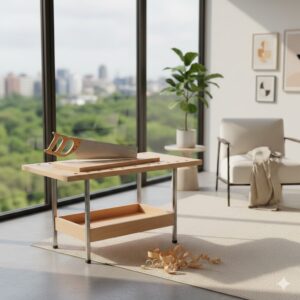
If you spend any time watching woodworking tutorials on YouTube, it is easy to get discouraged. Almost every creator seems to have a massive, three-car garage filled with giant table saws, 12-inch planers, and ceiling-mounted dust collection systems.
If you live in a one-bedroom apartment, a townhome with zero yard space, or only have a tiny balcony, you might think: “I guess I can’t be a woodworker.”
That is a massive myth. For centuries, beautiful, heirloom-quality furniture was built in tiny, cramped workshops in the middle of crowded cities. You do not need a 500-square-foot shop to make sawdust. You just need a shift in mindset, the right tools, and a bit of creativity.
In this guide, we will break down exactly how to start a woodworking hobby in a small space, covering tool selection, dust management, and how to build without angering your neighbors or your landlord.
Stop wasting time searching for incomplete plans online. Get instant access to 16,000+ Step-by-Step Woodworking Plans for every project imaginable (Chairs, Desks, Sheds, and more!).👉 [Click Here to Watch the Free Video & Download 50 Free Plans]
1. Embrace the “Hand Tool” Mindset
When space is your biggest limitation, traditional hand tools become your best friends. Power tools are fast, but they are loud, they throw fine dust everywhere, and they take up a massive footprint.
Hand tools, on the other hand, are quiet, compact, and create heavy wood shavings that fall straight to the floor (which are much easier to clean up).
Essential Small Space Tools:
The Japanese Ryoba Saw: As we discussed in our Hand Saw vs. Power Saw Guide, this pull-saw is thin, incredibly sharp, and perfect for apartment woodworking. You can cut down boards quietly without waking the baby next door.
Block Plane & Chisels: Instead of a loud electric router or sander, a sharp block plane and a set of chisels can smooth edges and cut precise joinery. (Check out our list of Tools Under $50 for great beginner chisels).
A 12V Cordless Drill: You still need to drill holes and drive screws. A compact 12V drill (like the Bosch we recommended in our Cordless Drill Guide) is small enough to fit in a kitchen drawer but powerful enough for furniture making.
2. Solving the Workbench Problem
You cannot build furniture on your living room carpet, and you definitely shouldn’t clamp boards to your glass dining table. You need a sturdy work surface, but you don’t have room for a massive 8-foot Roubo workbench.
Here are the best micro-workbench solutions:
The Portable Folding Workbench (The Workmate)
Brands like Black & Decker make portable workbenches (like the Workmate series) that fold completely flat. You can set it up on your balcony or in your living room, do your work, and then fold it up and slide it under your bed or into a closet when you are done. The top acts as a giant vise, which is perfect for holding wood while you saw or plane.
The Clamp-on Vise (Moxon Vise or Sjöbergs Smart Vise)
If you have a sturdy kitchen island or a solid desk, you can buy a portable, clamp-on workstation. These are small, thick wooden blocks with a built-in vise that temporarily clamp to your existing tables. They instantly convert any flat surface into a woodworking bench without causing damage.
The “Roman Workbench” (Low Bench)
This is an ancient solution making a huge comeback. A Roman workbench is a low, narrow bench (about knee height). Instead of standing, you sit on the bench and use your body weight to hold the wood down. It doubles as a stylish sitting bench in your hallway when not in use!
3. Dust Collection Without the Big Machines
The number one rule of indoor woodworking: Manage your dust. Breathing in fine wood dust is a serious health hazard, and it will quickly cover your electronics, couch, and kitchen counters in a fine film.
How to handle dust indoors:
Avoid the Router and Power Sander: These two tools create the finest, most toxic airborne dust. Indoors, swap the power sander for a card scraper or a hand plane. They produce heavy shavings instead of fine dust.
Get a Shop-Vac with a HEPA Filter: A standard household vacuum will just blow fine dust back into the air. Buy a small, 2-gallon wet/dry shop vacuum and upgrade the filter to a HEPA rated one.
The “Balcony Rule”: If you absolutely must use a power sander or a circular saw, do it on the balcony or in the parking lot.
Air Purifiers: If you are working in a spare bedroom, run a standard home air purifier with a HEPA filter while you work to catch any floating particles.
4. Managing Noise & Neighbor Relations
If you live in an apartment, noise is your biggest enemy. A circular saw screaming at 8:00 PM will get you an eviction notice faster than anything else.
Work During “Loud” Hours: Restrict your hammering and power tool use to Saturday afternoons when people are awake, out running errands, or making noise themselves.
Use a Mallet, Not a Hammer: When tapping chisels, use a wooden or rubber mallet instead of a steel hammer. It creates a dull “thud” rather than a sharp, piercing “crack” that travels through walls.
Padded Flooring: Put down a cheap anti-fatigue foam mat or a thick rug under your portable workbench. This absorbs the vibrations from your tools so they don’t echo down into your downstairs neighbor’s ceiling.
5. Storage: Where Do All the Tools Go?
When you don’t have tool chests, vertical storage is your best friend.
Tool Rolls: Canvas tool rolls are amazing for chisels, files, and marking tools. You roll them up into a tight burrito and throw them in a drawer.
The Pegboard Closet: If you have a spare closet, mount a 2×4 foot pegboard on the back wall. You can hang all your saws, squares, and drills neatly out of sight.
Under-Bed Totes: Store your actual lumber and scrap wood in long, flat plastic storage bins under your bed or couch. It keeps the wood flat (preventing warping) and completely hidden from guests.
6. Best Projects for Small Spaces
When your shop is tiny, your projects should be too. Building a 6-foot dining table in a living room is a nightmare. Instead, focus on small, high-value items.
Here is what you should start with:
Spoon & Bowl Carving: This requires zero power tools. Just a piece of wood, a carving knife, and a hook knife. You can do this sitting on your couch watching TV.
Small Wooden Boxes: Keepsake boxes and jewelry boxes teach you incredible precision and tight joinery, taking up very little room.
Items That Sell: Focus on small, boutique items like geometric coasters, cutting boards, or phone stands. In fact, we have a full guide on 10 Small Woodworking Projects That Sell Like Crazy Online—these are all perfect for balcony builders!
Conclusion: Start Where You Are
Don’t let the lack of a perfect workshop keep you from experiencing the joy of shaping wood. Some of the most highly skilled craftsmen I know work out of spare bedrooms and 5×10 foot storage units.
Start with a few quiet hand tools, a folding bench, and a small piece of pine. The space doesn’t make the woodworker; the passion does.