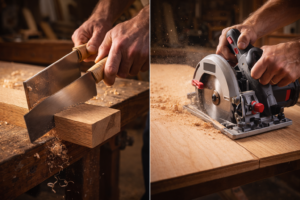
When you first decide to get into woodworking, the excitement is usually followed by a wave of confusion in the tool aisle. You stare at a $20 hand saw and a $150 circular saw and ask yourself the ultimate beginner question:
“Do I really need a power saw to start, or can I just use a hand saw?”
It is the oldest debate in the modern workshop. The traditionalists will tell you that true craftsmanship comes from hand tools. The modern builders will tell you that life is too short to cut a 2×4 by hand.
The truth? Both are right, depending on what you want to build, where you are building it, and what your budget is.
In this comprehensive guide, we are going to break down the pros and cons of hand saws vs. power saws so you can make the smartest choice for your new woodworking journey.
Stop wasting time searching for incomplete plans online. Get instant access to 16,000+ Step-by-Step Woodworking Plans for every project imaginable (Chairs, Desks, Sheds, and more!).
👉 [Click Here to Watch the Free Video & Download 50 Free Plans
]
The Hand Saw: The Traditionalist’s Choice
A hand saw relies on human power. Whether it is a classic Western push saw or a delicate Japanese pull saw (Ryoba), these tools have built houses, furniture, and ships for thousands of years.
The Pros of Hand Saws
Extremely Safe: The biggest advantage for beginners. While a hand saw can certainly cut you, it won’t violently kick back or cause catastrophic injuries like a spinning power blade can. When you stop moving, the saw stops cutting.
Budget-Friendly: You can buy a high-quality Japanese pull saw for under $40. It is a one-time purchase with no batteries, chargers, or electricity bills required.
Quiet and Clean: You can use a hand saw in an apartment at 2 AM without waking the neighbors. They also produce heavy wood shavings that fall to the floor, rather than fine, airborne dust that requires expensive vacuum systems.
Ultimate Control: Cutting by hand forces you to slow down. You can feel the grain of the wood. For delicate joinery (like dovetails or tenons), a hand saw offers precision that large power tools simply cannot match.
Zero Setup Time: No cords to untangle, no batteries to charge, and no depth gauges to set. You just grab the saw, put it on your pencil mark, and start cutting.
The Cons of Hand Saws
Physical Effort: Ripping a long board (cutting parallel to the grain) by hand is an intense workout. If you are building large projects, you will get tired very quickly.
Steep Learning Curve: A hand saw only cuts straight if you push it straight. It takes practice and muscle memory to keep the blade perfectly square to the wood.
Time-Consuming: What takes a circular saw 5 seconds can take a hand saw 5 minutes. If you have limited time on the weekends to build, hand saws will significantly slow down your progress.
The Power Saw: The Modern Workhorse
Power saws use an electric motor (corded or battery-powered) to spin or reciprocate a blade. This category includes circular saws, jigsaws, miter saws, and table saws. For this comparison, we will focus on the most common beginner power tool: the circular saw or jigsaw.
The Pros of Power Saws
Incredible Speed: Power saws melt through wood. If you need to cut down ten 2×4 boards for a workbench, a power saw turns a 30-minute sweating session into a 2-minute breeze.
Accuracy at Scale: With the help of fences and guides, a power saw can make perfectly straight, 90-degree cuts repeatedly. This is crucial for building box-like furniture (like bookshelves or cabinets) where square edges are non-negotiable.
Cuts Thick Materials Easily: Trying to cut a thick slab of hardwood or a massive sheet of 3/4-inch plywood by hand is brutal. A circular saw glides right through it.
Less Physical Strain: Let the motor do the work. This makes woodworking accessible to people of all ages and physical strength levels.
The Cons of Power Saws
High Initial Cost: A decent circular saw or miter saw will cost anywhere from $60 to $300+. You also have to buy expensive replacement blades and potentially batteries.
Intimidating and Dangerous: Power saws demand immense respect. They are loud, aggressive, and can cause serious injuries in a fraction of a second if you ignore safety rules.
Noise and Dust: You cannot use a power saw in a small apartment without angering your neighbors and covering your living room in a layer of fine, toxic dust. You need a dedicated outdoor space or a garage.
Requires Setup: You have to measure, clamp a straight edge, adjust the blade depth, put on safety gear, and manage the power cord before you make a single cut.
Head-to-Head Comparison
Let’s look at how they stack up against each other in the categories that matter most to a beginner:
| Feature | Hand Saw | Power Saw | Winner for Beginners |
| Safety | High (Low risk) | Low (Requires training) | Hand Saw |
| Speed | Very Slow | Extremely Fast | Power Saw |
| Initial Cost | Under $40 | $60 – $200+ | Hand Saw |
| Precision | High (with practice) | High (with guides) | Tie |
| Workspace Needed | Small (Indoors OK) | Large (Outdoors/Garage) | Hand Saw |
The Verdict: Which One Should You Buy First?
The answer to the “Hand Saw vs. Power Saw” debate isn’t about which tool is better overall. It is entirely about your specific situation and goals.
Choose a Hand Saw First If:
You live in an apartment or don’t have a dedicated garage workspace.
You are on a very tight budget (under $50).
You want to focus on small crafts, carving, or fine furniture with complex hand-cut joinery.
You are intimidated by the noise and danger of power tools.
Recommendation: Start with a high-quality Japanese Ryoba saw. It has two edges (one for crosscuts, one for rip cuts) and is incredibly beginner-friendly.
Choose a Power Saw First If:
You want to build practical furniture quickly (shoe racks, tables, workbenches).
You plan to work with large sheets of plywood.
You have a garage, driveway, or backyard to work in.
You are remodeling your house or doing DIY home repairs.
Recommendation: Start with a basic 7 1/4-inch corded circular saw. Pair it with a clamped straight-edge guide, and you can build almost anything. (Check out our Jigsaw vs. Circular Saw Guide if you are torn between power tools!)
The Hybrid Approach (The Best of Both Worlds)
The secret that experienced woodworkers know is that you don’t have to choose just one. In a practical workshop, these tools work together as a team.
Most modern woodworkers use a hybrid approach. They use a power saw to quickly break down large, heavy boards into manageable pieces, and then they switch to a hand saw to make precise, delicate cuts for the final joinery.
Don’t let tool snobbery tell you how to build. Grab the tool that fits your budget, respects your workspace, and gets you excited to make sawdust.