When I first decided to start woodworking, I made a huge mistake. I went online and looked at “Dream Workshops.” I saw massive table saws, giant band saws, and walls full of expensive gadgets.
I looked at my wallet, saw I had about $200, and almost gave up before I started.
Here is the secret that tool companies don’t want you to know: You don’t need a $2,000 table saw to build beautiful furniture. In fact, humans have been building incredible wooden structures for thousands of years with just a few hand tools.
If you are just starting out, you need to be smart with your budget. You need tools that are versatile, durable, and affordable.
In this guide, I have listed the 7 absolute essential tools that every beginner needs. The best part? Most of these cost less than $50, and you can build almost anything with this kit.
1. The Tape Measure (Your Roadmap)
We already covered this in our detailed guide on How to Read a Tape Measure, but it is worth repeating. You cannot build what you cannot measure.
Why you need it: Accuracy is everything.
What to buy: Look for a 25-foot tape measure. Make sure it has a sturdy “standout” (the tape stays straight when you extend it).
Budget Tip: Don’t buy the cheapest $2 one. Spend $10-$15 on a brand like Stanley or Milwaukee. It will last for years.
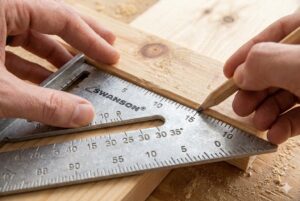
2. The Speed Square (The Magic Triangle)
This little triangular piece of metal is arguably the most useful tool in my shop.
Why you need it: It helps you draw perfect 90-degree (square) lines and 45-degree angles instantly. It also acts as a fence (a guide) for your circular saw to ensure your cuts are straight.
Durability: Buy a metal one (aluminum), not plastic. If you drop a plastic one, it breaks. If you drop a metal one, it dents your floor, but the tool survives!
3. A Quality Circular Saw
This will likely be your first “scary” power tool. While a table saw is nice, a circular saw is portable and can do 90% of the same cuts.
Why you need it: Breaking down plywood sheets and cutting lumber to length.
Tip: If you can afford it, go cordless. But if you are on a tight budget, a corded circular saw is much cheaper and actually more powerful.
Safety First: Always remember the 5 Essential Safety Rules when using this saw. It kicks back if you aren’t careful!
4. The Power Drill (Cordless)
You will use this on every single project. From drilling pilot holes to driving screws, a good drill is the heart of the modern workshop.
Drill vs. Impact Driver: As a beginner, just start with a standard Drill/Driver. It has a “clutch” (the spinning ring with numbers) that prevents you from driving screws too deep and cracking the wood.
Bits: Don’t forget to buy a small set of drill bits and screwdriver bits.
5. Clamps (You Can Never Have Enough)
There is an old joke in woodworking: “How many clamps do you need? Just one more.”
Why you need them: Clamps are your extra set of hands. They hold the wood tight while you glue, screw, or sand it.
Start with: Get two 6-inch bar clamps and two 12-inch bar clamps. Quick-grip style clamps are the easiest for beginners to use with one hand.
6. Random Orbital Sander
Sanding by hand is great for character building, but it is terrible for your patience. A Random Orbital Sander spins and wiggles at the same time, which prevents it from leaving scratch marks on the wood.
Why you need it: It turns a rough, ugly board into a smooth, professional-looking piece of furniture in minutes.
Paper: Buy sanding discs in 80 grit (rough), 120 grit (medium), and 220 grit (smooth).
7. A Set of Chisels
Even with power tools, sometimes you need to clean up a joint or carve out a small space for a hinge.
Why you need it: Precision. Power tools are for speed; hand tools are for finesse.
Maintenance: Chisels need to be razor sharp. A dull chisel is dangerous because you have to push too hard.
Conclusion: Start Small, Build Big
Do not rush out and buy all seven of these today if you can’t afford them. Start with a tape measure, a saw, and a drill. That is enough to build a workbench, a box, or a simple shelf.
As you grow, your tool collection will grow. But remember, the tool doesn’t make the craftsman—practice does.
What is the first tool you are planning to buy? Let me know in the comments below!
Frequently Asked Questions (FAQs)
Q: Should I buy Corded or Cordless tools? A: Cordless is more convenient, but Corded is cheaper and lasts forever. If you are working in a garage with power outlets, save money and buy corded tools to start.
Q: Do I really need a Table Saw? A: Not yet. A table saw is the centerpiece of a pro shop, but it is expensive and dangerous for total beginners. Master the circular saw first.
Q: What is the best brand for beginners? A: You don’t need top-tier pro brands (like Festool). Brands like Ryobi, Craftsman, or Black+Decker are perfect for weekend warriors and beginners.